


Reliable environmental data as added value for our customers
Transparent information on the environmental characteristics of raw materials is an important basis for making informed decisions in the construction industry. For manufacturers of concrete, mortar, plaster, coatings, and other building materials, reliable and comparable environmental data is therefore becoming increasingly important.
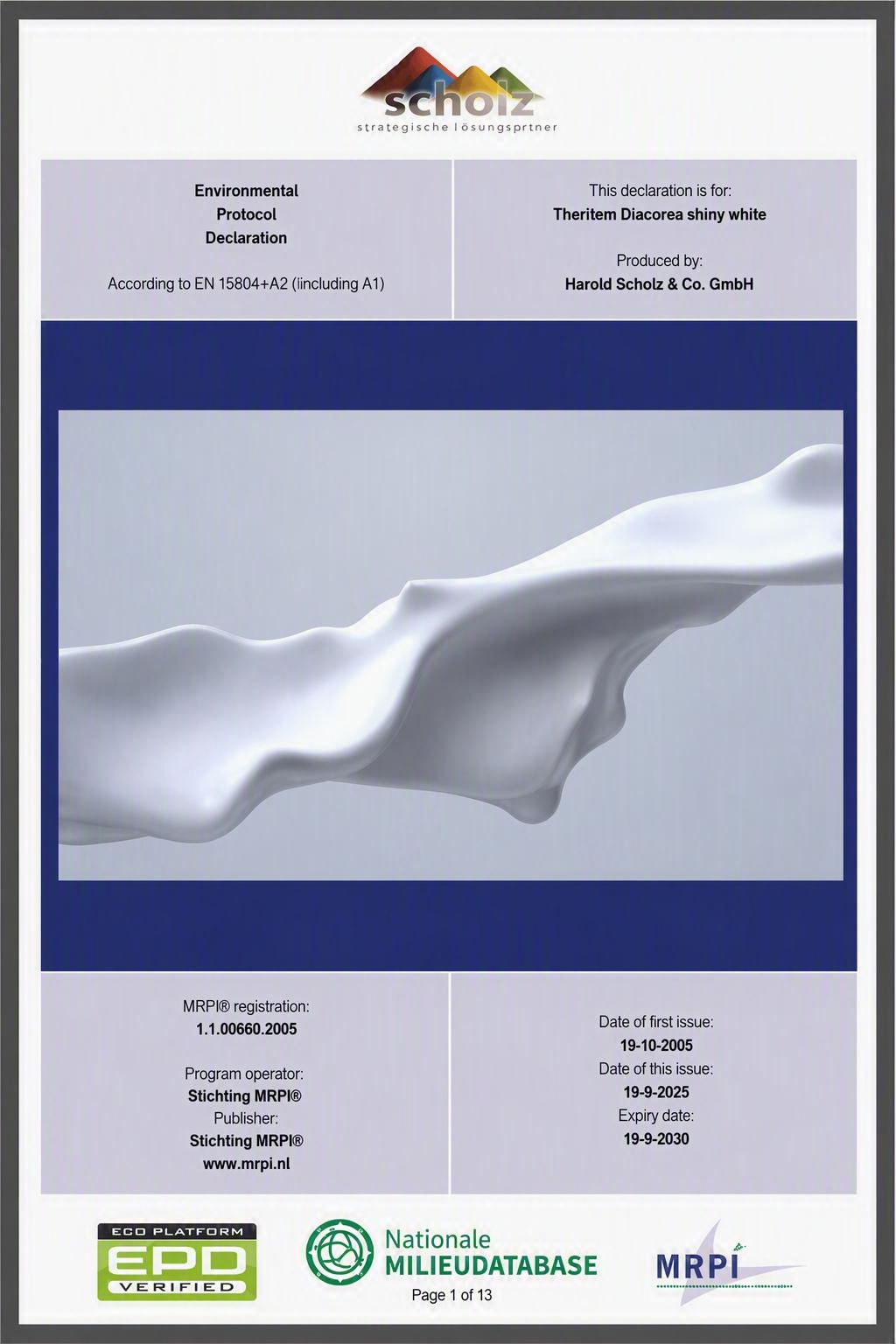
For our titanium dioxide slurry, we have had an independently verified Environmental Product Declaration (EPD) created and published via the Dutch program operator MRPI® – Milieu Relevante Product Informatie.
The EPD is based on EN 15804+A2 and was created with the requirements relevant to the Dutch market in mind. This allows us to provide our customers with product-specific environmental data that they can use for the ecological assessment of their own products and structures.
What is an EPD – and what does PCR mean?
An EPD (Environmental Product Declaration) is a standardized and independently verified environmental declaration. It is based on a Life Cycle Assessment (LCA) and transparently presents the environmental impact of a product across defined impact categories.
The methodological basis is formed, among other things, by so-called PCR – Product Category Rules. They define the rules according to which the environmental impacts of a specific product group are determined and presented. Simply put:
PCR → defines the calculation rules
LCA → determines the environmental impacts
EPD → documents the results in a transparent and comparable way
For our EPD, EN 15804+A2 forms the methodological basis. Inorganic pigments are considered in this process.
Why is the NMD relevant in the Netherlands?
The Netherlands has the National Environmental Database (NMD) about an established national system for environmental data on construction products and their use in environmental performance calculations for buildings.
It is important to note a key distinction: an MRPI-EPD and an entry in the NMD are not the same thing.
An MRPI-EPD is independently verified and published by MRPI. Including the underlying data in the NMD, however, is a separate process with its own verification and approval steps. A product card is only published in the NMD after successful verification.
Our EPD should therefore not be interpreted as a guarantee of NMD listing. Rather, we provide an independently verified and published environmental declaration that has been prepared with the requirements of the Dutch system in mind.
In doing so, we provide our customers with a reliable, product-specific data module for their own environmental assessments.
MKI and ECI – the Dutch perspective
In the Dutch construction industry, the terms MKI and ECI play an important role.
MKI – Milieukostenindicator – is an environmental cost indicator that combines various environmental impacts into a single monetized metric. The MKI is particularly relevant in the GWW sector (grond-, weg- en waterbouw), such as in road and civil engineering.
ECI – Environmental Cost Indicator refers to the same principle in an English-speaking context. The relationship can be simplified as follows:
EPD → provides product-specific environmental data → LCA → assesses environmental impacts → MKI/ECI → enables these to be combined into a single monetized metric.
For our customers, this means: the environmental data for our titanium dioxide slurry can be included as a component in the LCA of their own construction product.
Why is this relevant for a pigment supplier?
A pigment is often just one component of a construction product. However, for a reliable life cycle assessment, the relevant raw materials used must be represented as specifically as possible.
If product-specific environmental data is missing, generic datasets or other data sources may have to be used. Our EPD creates greater transparency here and improves the available data basis for our customers' environmental accounting. We therefore do not just supply the pigment – we also supply the associated, independently verified environmental information.
The Netherlands and Germany: a common European foundation, different systems
Both the Netherlands and Germany rely on the European EN 15804 standard for construction product EPDs. However, the specific use and integration of environmental data take place via different national systems.
In the Netherlands, the Nationale Milieudatabase (NMD) plays a central role. In the building sector, the MPG (Environmental Performance of Buildings) relevant, while the MKI is used in particular in the infrastructure and civil engineering sectors.
In Germany, however, the ÖKOBAUDAT plays a central role as a database for life cycle assessment within German sustainability certification systems.
As a result, the systems are not directly interchangeable, even though they are based on common European LCA and EPD principles. The difference lies primarily in national integration, assessment methods, databases, and specific use cases.
Our contribution: reliable data for our customers
As a pigment supplier, we see our responsibility as extending beyond the reliable delivery of high-quality products. For us, reliability also means providing dependable technical and environmental data.
Our titanium dioxide slurry EPD provides our customers with an independently verified and publicly accessible environmental declaration. It is particularly relevant for customers who assess their products or structures for the Dutch market according to the methods applicable there.
The responsibility for their own LCA and any necessary NMD audits remains with the respective customer. Our role is to provide a robust, product-specific data module for this purpose.
Our EPD at a glance
Product: Titanium Dioxide slurry white
Manufacturer: Harold Scholz & Co. GmbH
MRPI registration: 1.1.00992.2025
Publication date: September 18, 2025
Validity: until September 18, 2030
Functional unit: 1,000 kg
Basis: EN 15804+A2
EPD program: MRPI®
LCA specialists: Ecochain Technologies B.V.
Independent verification: accredited MRPI® verifierr